Lydia P Brownlow
  • Home
  • Vermilion Sunrise
  • The Author
  • Resources
  • Science Behind the Science Fiction
  • Contact & Events
THE SCIENCE BEHIND

ORBITS

In space, gravitational forces create trajectories where celestial objects move around each other in elliptical paths. We call this effect of gravity an orbit. Some orbits, like the Earth moving around the Sun, are almost circular. A group of planets orbiting a single star (as in our solar system), typically orbit that star on the same plane. Scientists believe these coplanar orbits are a result of the system's formation from a disk of dust surrounding the star.
A video by Insane Curiosity, September 2022
Some orbits exhibit synchronous tidal locking. The orbit of Earth's moon is one example. We always see the same side of the moon because the time it takes the moon to spin on its axis is the same amount of time it takes to orbit the Earth; therefore, one side of the moon is always facing us, while the "dark side" of the moon remains hidden.​
Picture
Picture
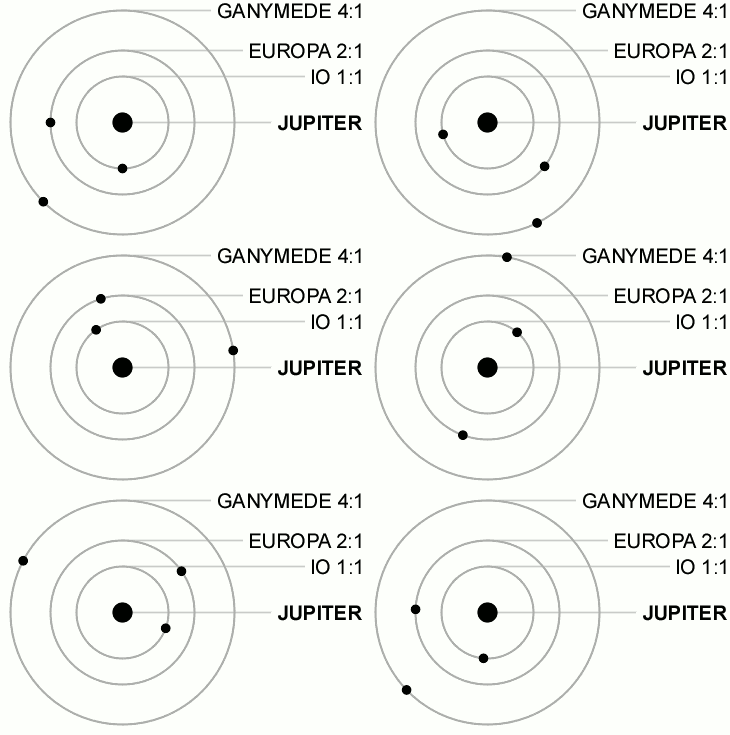
Above: Laplace resonance demonstrated by three of Jupiter's Galilean moons.
Orbital resonance occurs when orbital periods have integer (whole number) ratios. For example, Pluto and Neptune have a 2:3 resonance. For every 2 times Pluto orbits the Sun, Neptune orbits it 3 times.
One of the first observations of orbital resonance was made by Pierre-Simon Laplace, a French scientist, mathematician, and philosopher of the late 18th and early 19th centuries. Laplace observed that three of Jupiter's largest moons orbit in a 4:2:1 ratio. Europa's orbital period is 2 times as long as Io's, and Ganymede's orbital period is 4 times as long as Io's. This 4:2:1 orbital resonance is called a Laplace Resonance. ​
Click on the colorful image to access the orbits of Jupiter's Galilean Moons put to sound and video.

It includes an explanation of orbital resonance.

System Sounds: Andrew Santaguida, Matt Russo, and Dan Tamayo.
Picture
ADDITIONAL RESOURCES​
Picture
What is an Orbit?
A part of the NASA Knows series for grades 5-8, last updated February 2025.
Picture
Orbital Plane
An infographic of our solar system by National Geographic​.

Picture
Tidal Locking
Earth's Moon, written by Tracy Vogel and graphics designed by Vi Nguyen, NASA.

Picture
What is Tidal Locking?
​
by Fraser Cain
for Universe Today, Phys.org.

Picture
Orbital Resonance
From Astronomy & Astrophysics, EDP Sciences, the European Southern Observatory.

Picture
Six Alien Planets Have Been Found Locked in a Rare, Complex Orbital Dance
​by Michelle Star
​for ScienceAlert, Space, February 2021.
Proudly powered by Weebly
  • Home
  • Vermilion Sunrise
  • The Author
  • Resources
  • Science Behind the Science Fiction
  • Contact & Events