Lydia P Brownlow
  • Home
  • Vermilion Sunrise
  • The Author
  • Resources
  • Science Behind the Science Fiction
  • Contact & Events
THE SCIENCE BEHIND

EPSILON ERIDANI: THE STAR

Picture
Moroccan Astrolabe, 1500s
Picture
The Story of the Astrolabe, the Original Smartphone
​ by Laura Poppick, Smithsonian Magazine, 2017.

​An explanation of the scientific invention that first helped map stars such as Epsilon Eridani.
Epsilon Eridani (Ɛ Eridani) is visible from most of the Earth's surface because of the star's location, its relative proximity (10.5 light-years from Earth), and its luminosity.

​Epsilon Eridani is a spectral class K2 star, colloquially known as an "orange" star because of its orange tint when seen in the night sky by human eyes.
Compared to our Sun, Epsilon Eridani is a relatively young star with slightly less mass and more magnetic activity.

​In 2015, the International Astronomical Union formally designated the star as Ran, named after Rán, a sea goddess of Norse mythology. ​
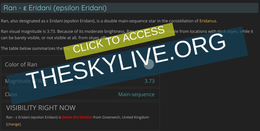
Click the image to access the star page on TheSkyLive.com.

​It includes an interactive function that shows whether you can currently see Epsilon Eridani in your own night sky and where.
Picture
Picture
Claudius Ptolemy, an image of the 2nd century astronomer from a 1500s engraving
The star has been catalogued by observers since at least the 2nd Century, when the ancient Greek astronomer Claudius Ptolemy included it in his treatise the Almagest. 

​Epsilon Eridani continued to be part of influential astronomical catalogues throughout the centuries and throughout the world. It was included in works by Abd al-Rahman al-Sufi and other medieval astronomers of the Islamic Golden Age and in the 1603 star atlas published by Johann Bayer, a German celestial cartographer whose naming designations are still used today.
ADDITIONAL RESOURCES​
The Color of the Stars from Hottest to Coldest
by Anne Helmenstine. An overview of star colors/temperatures last updated May 2023 for Science Notes.

Picture
Stellar Classifications
National Schools' Observatory, Liverpool, UK.

Picture
Orange Stars are Just Right For Life
by David Shiga for NewScientist magazine, May 2009.

Picture
NameExoWorlds Contest Results
The National Astronomical Observatory of Japan
Picture
New Star and Exoplanet Names Ok'd by IAU
by J. Kelly Beatty for Sky & Telescope, December 2015.
Proudly powered by Weebly
  • Home
  • Vermilion Sunrise
  • The Author
  • Resources
  • Science Behind the Science Fiction
  • Contact & Events